
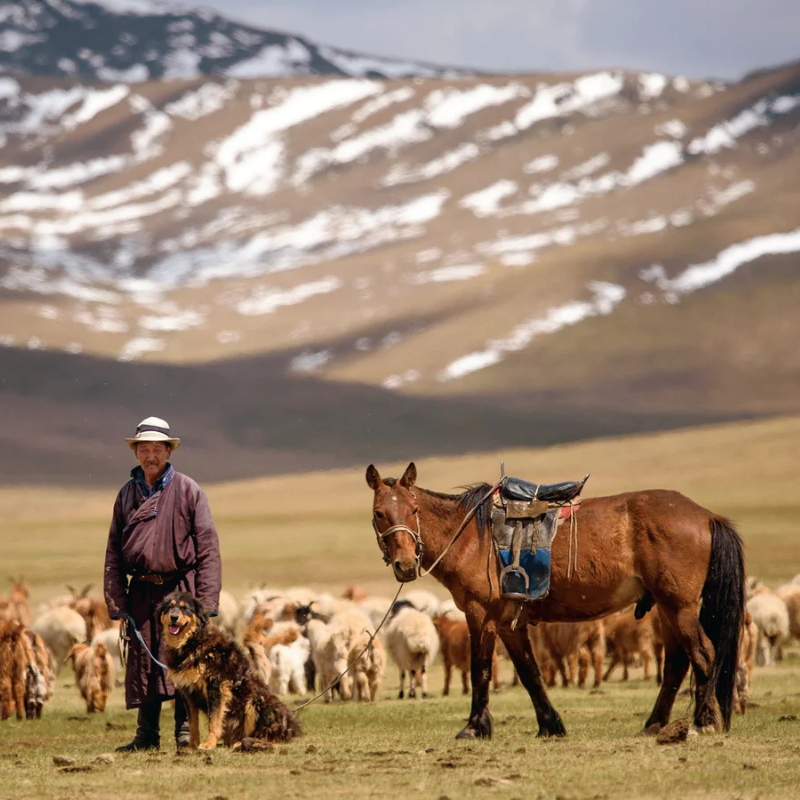
Across Mongolia’s vast grasslands, livestock herding remains the foundation of nomadic life and the defining rhythm of the steppe. For generations, herder families have guided their animals across seasonal pastures, moving in response to weather, water, and grazing conditions. This pastoral tradition is not only an economic livelihood but a finely tuned ecological relationship between people, animals, and landscape — one that has sustained nomadic society for centuries.
Ride alongside Mongolian herders across open steppe landscapes and experience the timeless art of pastoral life in motion.
Daily herding requires skill, endurance, and deep knowledge of animal behavior and terrain. Mounted on hardy Mongolian horses, herders gather, guide, and protect mixed herds of sheep, goats, cattle, horses, and yaks across sweeping valleys and rolling plains. Seasonal migrations — from lush summer grasslands to sheltered winter camps — reflect an intimate understanding of climate and ecology. Travelers accompanying herders may observe or assist in livestock gathering, foal tethering, or pasture movement, gaining rare insight into pastoral techniques refined over generations.
Herding on the steppe reveals a profound harmony between mobility and landscape. Without fences or fixed boundaries, animals graze freely under constant human stewardship, and herders navigate vast open terrain using memory, landmarks, and instinct. The experience offers a sense of scale and freedom unique to Mongolia — where sky, grassland, and movement merge into a continuous horizon.
Participating in steppe herding allows travelers to witness living nomadic knowledge in practice. From horseback coordination and herd management to seasonal camp life and environmental adaptation, this immersive encounter reflects the resilience and sustainability of Mongolia’s pastoral culture. It is a dynamic expression of a way of life shaped by movement, animals, and the enduring rhythms of the steppe.
No comment