Gobi Desert Southern Mongolia
GREAT GOBI DESERT - LAND OF LIVING HISTORY
The Great Gobi Desert is one of Mongolia’s most extraordinary natural regions. In 1975, the Mongolian government established the Great Gobi National Park, and in 1991 UNESCO designated it as the fourth largest Biosphere Reserve in the world.
Although many people imagine the Gobi as a vast, empty sandy desert, this is far from reality. Mongolians recognize 33 different types of Gobi, and pure sand covers only about 3% of the total area. The region is rich in wildlife, vegetation, dramatic landscapes, and deep history.
The Gobi is famous as the land of dinosaurs, where some of the world’s most important dinosaur fossils and petrified eggs have been discovered. It is also home to traditional camel herders and rare wildlife such as wild asses, Bactrian camels, gazelles, mountain sheep, snow leopards, and the extremely rare Gobi bear (Mazaalai)—found nowhere else on Earth.


The Singing Dunes of the Gobi
KHONGOR SAND DUNES
The Khongor Sand Dunes, also known as Khongoryn Els, are among the top attractions of Gobi Gurvan Saikhan National Park. Stretching from northwest to southeast, the dunes reach up to 200 meters (650 feet) in height and cover nearly 1,000 square kilometers.
The landscape here is incredibly diverse:
The southern part is rocky and mountainous
The central part is barren, with pure sand
The northern part features green oases fed by the Khongor River
On windy days, the sand rises like a storm, and visibility can disappear completely. On calm, sunny days, the dunes glow golden and silver, changing colors throughout the day—especially beautiful at sunrise and sunset.
The widest section is known as the “Singing Dunes.” When you climb them, the sand produces a deep, humming sound, similar to a plane engine, caused by dry sand moving in the wind. This natural phenomenon makes Khongor one of the most fascinating places in the Gobi.
Birthplace of Dinosaur Discoveries
Bayanzag (Flaming Cliffs)
Bayanzag, also known as the Flaming Cliffs, is one of the most famous paleontological sites in the world. The area was once the bottom of an ancient sea around 60–70 million years ago.
The site was named by American explorer Roy Chapman Andrews, who led expeditions to Mongolia in the 1920s. During his research, he discovered dinosaur fossils and eggs in Bayanzag and nearby Nemegt. His findings were transported by 70 camels, and one of the major dinosaur skeletons is now displayed in the Natural History Museum of Ulaanbaatar.
In total, Andrews identified 10 dinosaur species, 8 of which were first discovered in Mongolia. Today, Bayanzag is not only important for science but also a stunning natural landscape with red sandstone cliffs, desert vegetation, and wildlife such as gazelles, wild asses, and wolves.


The White Stupa
TSAGAAN SUVARGA
Tsagaan Suvarga, meaning White Stupa, is a spectacular sandstone formation located about 156 km from Mandalgovi, the capital of Dundgovi Province.
The cliffs stretch for 400 meters and rise up to 60 meters high, resembling a giant ruined castle. The formations are composed of layered sediment rich in iron and calcium, creating beautiful bands of white, yellow, pink, and red as the minerals oxidize in the open air.
From the top of the cliffs, visitors can enjoy panoramic views of colorful hills fading into wide valleys. According to local legends, this area was once covered by an ancient sea, and the exposed seabed formed these dramatic shapes after the water disappeared.
Sunset at Tsagaan Suvarga is especially breathtaking, but visitors should be cautious—strong winds and loose ground require careful walking.
Valley of the Bearded Vulture
YOLYN AM
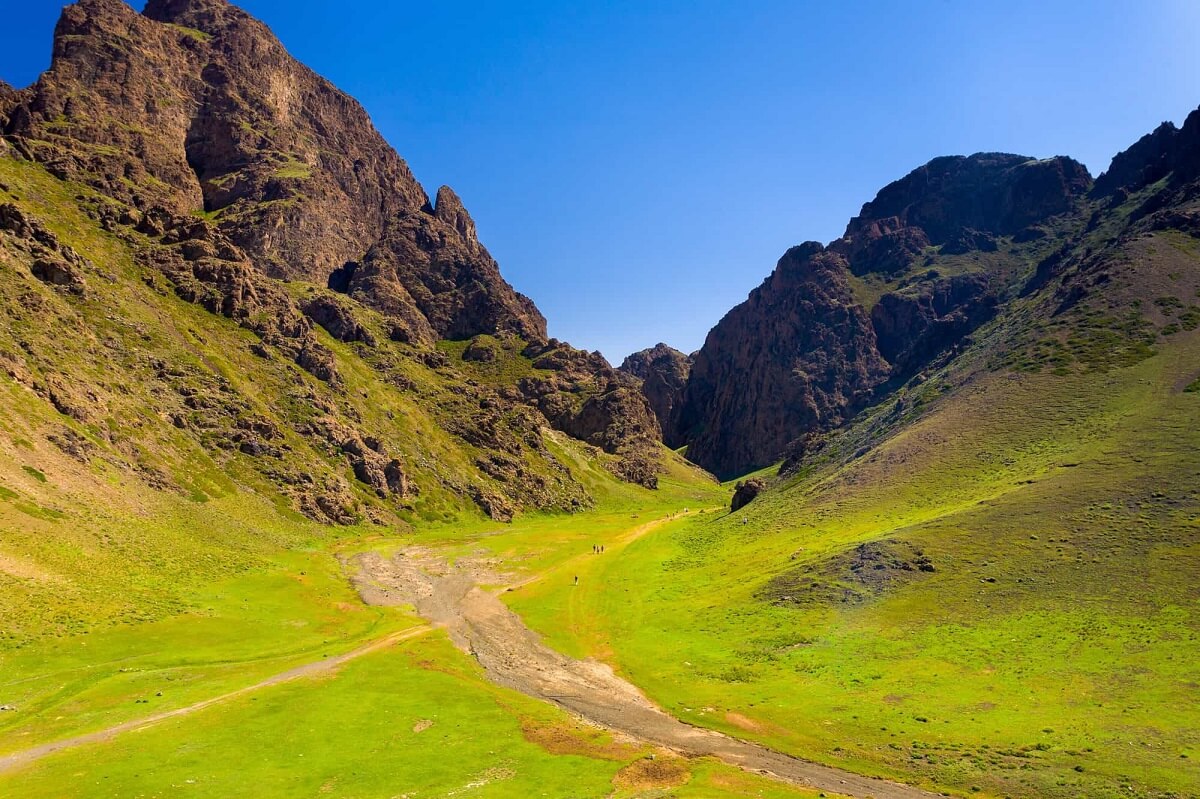
Yolyn Am Valley is located in the eastern part of the Gurvan Saikhan Mountains and has been protected since 1965. It is one of the Nine Natural Wonders of South Gobi Province.
A narrow stream flows through steep rocky gorges, creating a unique hiking experience where visitors cross the stream multiple times. In winter, the water freezes into thick ice that often remains until mid-July, making it possible to see ice in the middle of summer.
The valley is named after the Bearded Vulture (Yol), the largest bird of prey in Mongolia. These birds are unique because 70–90% of their diet consists of bones. Other wildlife includes ibex, wild sheep, pikas, rare birds such as Altai's snowcock a wall creeper .... etc, and—very rarely—snow leopards.


Ancient Stories in Stone
KHAVTSGAIT PETROGLYPHS
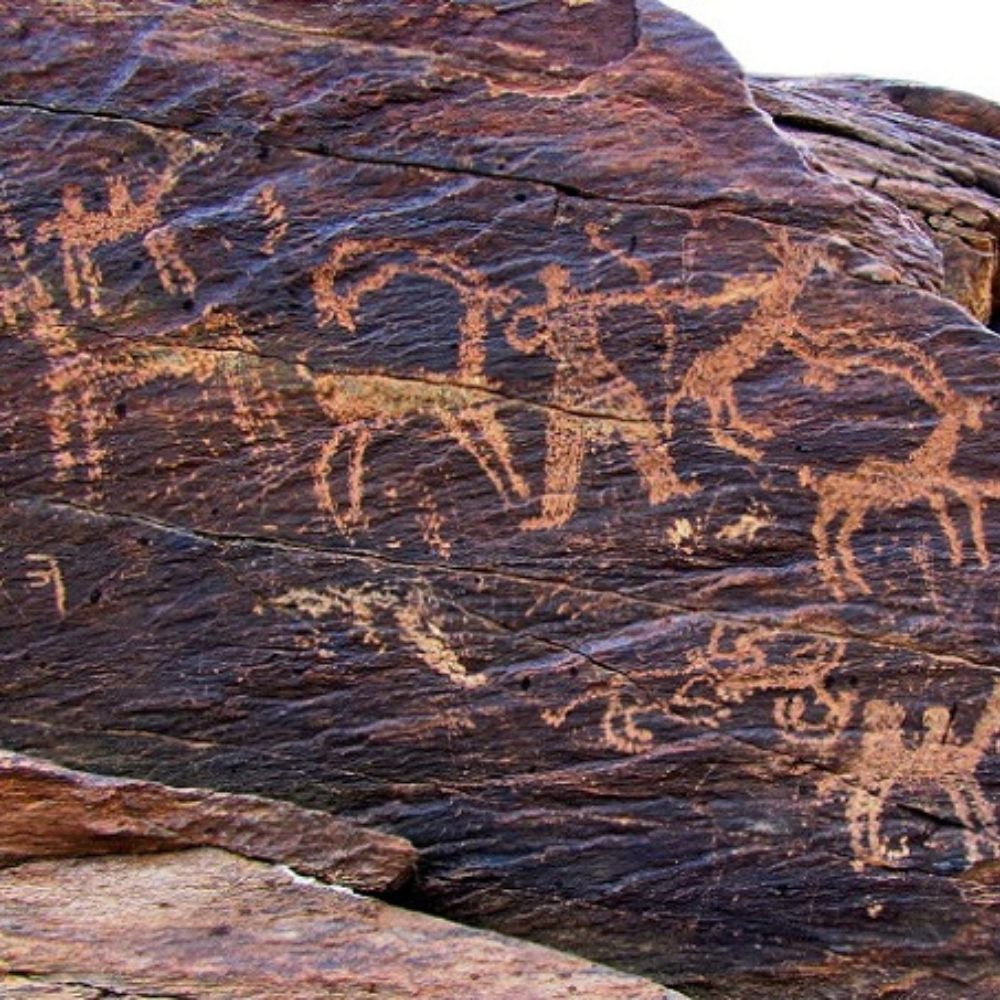
The Khavtsgait Petroglyphs, located about 30 km from Bulgan soum, date back 4,000–5,000 years to the Bronze and early Iron Ages.
Dark sandstone surfaces made by sun and wind erosion provided a perfect canvas for ancient artists. The carvings depict:
- Galloping horses
- Hunters and riders
- Camels and wheeled carts
- Argali sheep and ibex
- Wedding scenes and early gers
The highlight is the “Khavtsgait Gallery”, a single flat rock covered with multiple scenes drawn by people from different historical periods.
Dragon’s Grave
NEMEGT MOUNTAIN
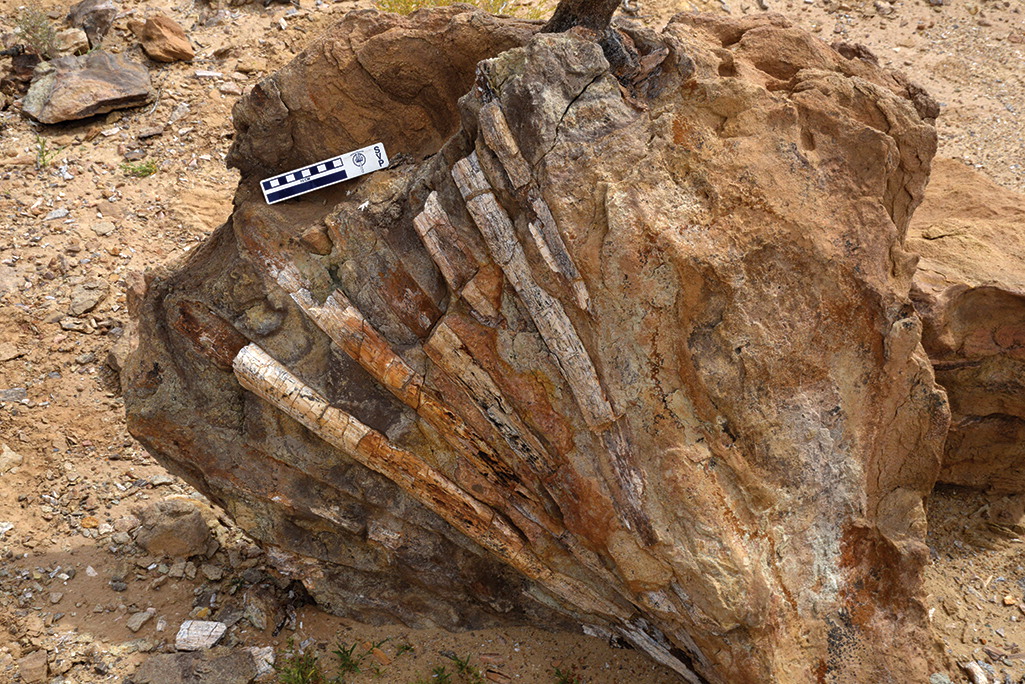
Nemegt Mountain, known as Dragon’s Grave, is one of the world’s most important dinosaur research sites. Located deep in the South Gobi, the area features vast canyons and clay formations similar to Bayanzag.
International expeditions in the 1960s and 70s discovered numerous fossils here, including Nemegtosaurus, named after this region. Standing on the flat mountain top, visitors can see endless canyons stretching into the horizon.


Granite Wonderland
BAGA GAZRIIN CHULUU
Baga Gazriin Chuluu is a granite rock formation in Dundgovi Province, famous for its natural sculptures, caves, petroglyphs, and ancient ruins.
Key sites include:
Sudutiin Am temple ruins
Ger Chuluu petroglyphs
Eye Spring (believed to heal eyesight)
Jargalant Cave
64 Hun graves discovered in 1989
Despite being in the Gobi, the area features rare aspen trees, wildlife, and dramatic granite formations shaped by wind and time.
Sacred Ruins of the Gobi
ONGIIN KHIID
Ongi Monastery was once one of Mongolia’s largest and most influential Buddhist centers, with 17 temples and over 1,000 monks in the early 20th century.
Destroyed during political repression in the 1930s, the ruins remain a powerful spiritual site. Today, visitors can explore restored temples, a ger museum, sacred mountains, meditation caves, and surrounding archaeological sites.


The Historical and Cultural Heart of Mongolia
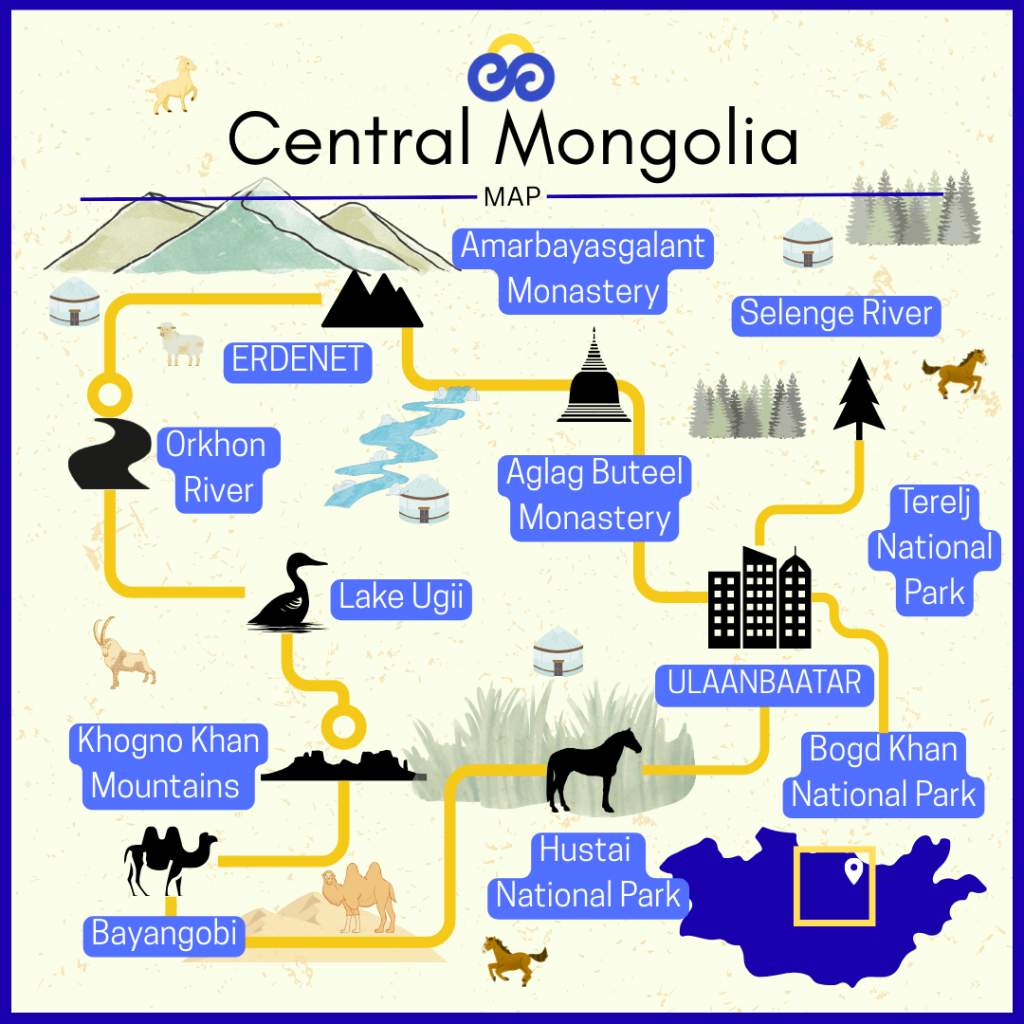
CENTRAL MONGOLIA
Central Mongolia is the core region of Mongolian history, nomadic civilization, and natural diversity. This vast area was the heartland of the Great Mongol Empire, where political power, religion, culture, and nomadic traditions developed over thousands of years. Wide grasslands, river valleys, forests, volcanoes, lakes, and sacred mountains together form a landscape that has supported human life from prehistoric times to the present.
Ancient people once lived here, leaving behind deer stones, rock carvings, burial mounds, and ritual sites that still stand today. Later, powerful empires such as the Huns, Turkic Khaganates, Uighurs, and the Mongols chose Central Mongolia as their center because of its fertile land, strategic location, and abundant water sources.
Khorgo-Terkhiin Tsagaan Nuur National Park
Volcanoes, Lava Fields, Forests & Alpine Lake
Khorgo–Terkhiin Tsagaan Nuur National Park is one of the most geologically fascinating regions in Mongolia. Officially declared a national park in 1994, the area covers 76,893 hectares and lies about 180 km from Tsetserleg, the capital of Arkhangai Province. The park sits at an altitude of 2,100–2,500 meters, between the Khangai and Tarvagatai mountain ranges.
Geological Background
This area was shaped by intense volcanic activity during the Miocene, Pliocene, Pleistocene, and Holocene periods. The most dramatic feature is Khorgo Volcano, an extinct volcano that last erupted around 11,700 years ago. When hot lava flowed through the valley, it blocked a river and formed Terkh White Lake, one of Mongolia’s most beautiful freshwater lakes.
Khorgo Volcano: about 200 m high, crater depth around 100 m, diameter approx. 400 m
Over 30 small extinct volcanoes are scattered around the area


The Historical and Cultural Heart of Mongolia
Terkh White Lake
Terkh White Lake lies at 2,060 meters above sea level and covers 61 square kilometers. It is 16 km long and 6 km wide. The lake feeds the Suman River, which later joins the Chuluut River. Its clear water, islands, and wetlands create an ideal habitat for wildlife and birds.
Flora & Landscape
Thanks to ancient glacial deposits, the soil here is relatively humid compared to other regions of Mongolia. Forests of Siberian larch and Siberian cedar cover the northern slopes, while marsh and aquatic plants grow around the lake. Mountain steppe, lava fields, and strange basalt rock formations give the park a surreal appearance.


Wildlife
The park is home to around 22 species of mammals, including:
Red deer, roe deer, musk deer
Wild boar, Mongolian marmot
Grey wolf, red fox, corsac fox
It is also a bird paradise, especially around Terkh White Lake. Rare and endangered species such as swan goose, cinereous vulture, saker falcon, and great bustard can be seen here. Migratory birds stop at the lake during seasonal movements, and the islands are used as nesting grounds.
Cradle of Nomadic Civilization
Orkhon Valley Cultural Landscape
The Orkhon Valley is one of the most important cultural landscapes in Mongolia and was inscribed as a UNESCO World Heritage Site in 2004. Located about 360 km west of Ulaanbaatar, the valley represents more than 2,000 years of continuous nomadic pastoral culture.
The Orkhon River, Mongolia’s longest river, flows through the valley for 1,124 km before joining the Selenge River and eventually reaching Lake Baikal. Because of its fertile land, fresh water, and strategic position, the valley became the political and cultural center for many civilizations.
Historical Importance
Empires that ruled from this valley include:
The Huns
Turkic Khaganates
Uighur Empire
Mongol Empire
Each left behind cities, memorials, temples, and archaeological remains that tell the story of Central Asia’s history


From Imperial Capital to Sacred Monastery
Karakorum & Erdene Zuu Monastery
Karakorum was founded in the 13th century as the capital of the Mongol Empire. Stones from the ruined city were later used to build Erdene Zuu Monastery in 1586, Mongolia’s oldest surviving Buddhist monastery.
At its height, Erdene Zuu had 64 temples and more than 1,000 monks. The monastery is surrounded by 108 white stupas, symbolizing Buddhist perfection and enlightenment. Today, it serves as both an active monastery and a museum, offering insight into Mongolia’s religious revival and history.
Mongolia’s Largest Waterfall
Orkhon Waterfall
Orkhon Waterfall, also known as Ulaan Tsutgalan, is the largest waterfall in Mongolia, dropping 25 meters into a volcanic canyon. It was formed by ancient lava flows that altered the course of the Orkhon River.
Visitors can hike down to the base of the waterfall, sit beside the roaring water, and explore the surrounding volcanic landscape. The area is also a summer grazing ground for nomadic families.


Sacred Mountain Retreat
Tuvkhun Monastery
Tuvkhun Monastery was founded in 1653 by Zanabazar, the first spiritual leader of Mongolian Buddhism. Built high on Shireet Ulaan Mountain (2,268 m), it served as a meditation retreat and artistic workshop.
This is where Zanabazar created the Soyombo script, now a national symbol on Mongolia’s flag. Reaching the monastery requires a 5 km hike, passing forests, cliffs, meditation caves, and sacred ovoos. The journey itself is a spiritual experience.
Mongolia 2025
Tom and Kelda S.
Our trip to Mongolia was one of the most unforgettable travel experiences we’ve ever had — raw, vast, deeply cultural, and unlike anywhere else in the world. We cannot thank Duuya enough for guiding us in Ulaanbaatar, the Gobi Desert, and at the thrilling Golden Eagle Festival.
Duuya started our tour in the surprisingly modern city of Ulaanbaatar including monasteries and museums (learning about the Mongol Empire, Genghis Khan, early tools, clothing with exquisite fabrics, nomadic life, etc), great restaurants (the first and only time we have been served by a robot), and the best cashmere shopping in the world (she knows just where to go!).
Next, we experienced the magic of the Gobi Desert. She had excellent drivers that took us to the Flaming Cliffs for photography, where it was raining so hard we stopped in a coffee shop (that seemed to appear out of nowhere), and before long she hurried us into our vehicles to photograph a rainbow spanning the major global paleontological hotspot. What shots we got! She set up another fabulous photographic opportunity by working with local nomadic camel herders to walk the two-humped Bactrian camels through the arid desert while wearing traditional clothing (a special experience that we would not have had without her!).
For the final stop, we went west for the Golden Eagle Festival. We knew that watching the eagle hunters compete was going to be mesmerizing, but to top it off, Duuya connected with three of the local hunters to get us a private photo session in a river surrounded by snow-covered mountains with their horses and eagles. Now you cannot beat that, it was not only a special experience, but it was followed by impressive photos. I doubt anyone else at the Festival had this private opportunity.
They say it is ‘who you know’ in life that can create opportunities, and I’m thrilled to know Duuya, as she has extensive contacts throughout Mongolia to provide deep cultural connections and opportunities. In fact, one of my favorite portrait photography shots of my life was taken on this trip with a nomad family she set up for us to meet in their ger (yurt). Thank you, Duuya, for your superior organizational skills, dedication to our comfort, and for sharing your wild, spiritual, and resilient culture with us. We look forward to returning to Mongolia and, without a doubt, will travel with Duuya again.
Rating:5*
----------------------------------------------------------------------------------------------------------------------------------------------------------

GET 20% OFF ON NEXT VACATION
ONLY FOR OUR GOLD LEVEL USERS